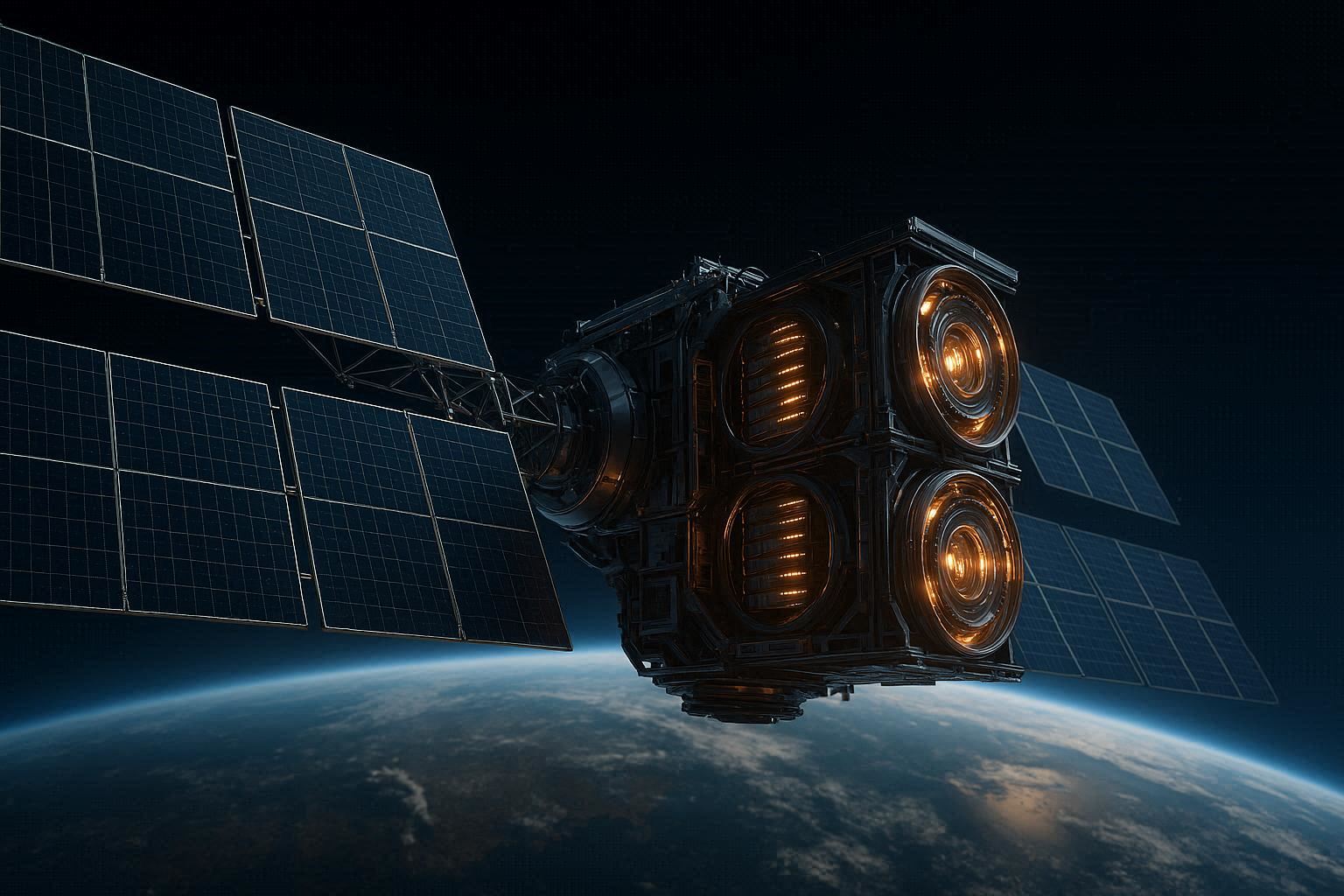
The explosive growth of artificial intelligence is pushing the world’s data infrastructure to new limits. As AI demand skyrockets, experts are raising a bold idea: data centres powering future AI systems may soon leave Earth entirely and operate in orbit around the planet. The reasoning is simple — conventional ground-based data centres are running into land, energy, cooling and environmental constraints that may soon become unsustainable.
This may sound like science fiction, but leading tech companies and startups are already exploring space-based AI data infrastructure as a long-term strategy. Here’s how this trend is unfolding and why it could reshape the future of computing.
Why Space for Data Centres?
Traditional data centres consume massive amounts of energy, require growing parcels of land, and demand intense cooling and water resources. As AI models grow larger and more power hungry, these needs are outpacing what many regions can sustainably support.
Space offers potential advantages:
-
Uninterrupted solar power: In orbit, large solar arrays could generate near-continuous energy without night cycles or weather interruptions.
-
Minimal cooling challenges: The vacuum of space naturally permits passive radiative cooling if engineered correctly.
-
New capacity frontier: Without terrestrial land or grid constraints, developers can pilot novel infrastructure concepts for massive AI workloads.
Visionaries argue that in the long run, these factors could help deliver energy at scale for AI training and inference workloads that today strain even the largest ground data centres.
Who’s Exploring This Idea
A growing mix of startups and major tech companies are pouring thought, prototype efforts, and research into orbiting compute infrastructure:
-
Starcloud: Claims to have launched the first operational orbital data centre satellite with onboard AI GPUs, pushing the boundary for space-based AI compute.
-
Google: Has launched Project Suncatcher, aiming to test powerful solar-powered AI satellites that could serve as distributed computing nodes in orbit.
-
Orbit AI & DeStarlink: Industry collaborations are working on early “orbital cloud” concepts combining connectivity and compute in low Earth orbit powered by solar energy.
-
Tech visionaries: Leaders including Elon Musk, Jeff Bezos, Sam Altman, and Jensen Huang publicly discuss the space data centre idea as part of a long-term infrastructure strategy.
These efforts are still early in development, but they represent concrete steps toward realizing what was once only a futuristic concept.
Practical and Economic Challenges
Despite the promise, building data centres in space faces significant hurdles:
-
Launch costs: Sending heavy computing hardware into orbit remains expensive — several thousand dollars per kilogram with existing rockets.
-
Maintenance and upgrades: Space hardware must be robust and designed for difficult conditions, and replacing chips every few years poses logistical complexity.
-
Latency and connectivity: High-speed communication between orbit and Earth is essential for efficiency and remains technically complex. Analysts debate whether the benefits outweigh constraints in practice.
Many experts say orbital AI data centres are likely decades away from being cost-effective compared with terrestrial solutions — but the trend is gaining traction as data-hungry AI workloads expand.
Implications for the AI Industry
If successful, orbital data centres could transform how AI is built and scaled:
-
Lower environmental impact: Over time, space infrastructure could reduce pressure on Earth’s grids and cooling resources.
-
Global networked compute: Distributed orbital nodes may enable seamless global compute platforms that complement ground networks.
-
Strategic infrastructure: Nations and companies could compete to control next-generation compute capabilities beyond Earth.
This space-based push is part of a broader global race. Nations, corporations, and startups are investing heavily in AI infrastructure on the ground and looking to the sky for long-term solutions.